
Top 3 Recommended Policies

By: Jackson Hering
Licensed Personal Insurance Specialist
425-409-2497
Running a print shop in Washington means managing risks that most small business owners don't think about until something goes wrong: a $200,000 wide-format printer destroyed by a burst pipe, a client suing over a misprinted wedding invitation, or an employee developing respiratory issues from prolonged ink exposure. Print shop insurance in Washington isn't just a box to check. It's the financial backbone that keeps your doors open when the unexpected hits. Washington's unique regulatory environment, from its state-run workers' compensation fund to strict Department of Ecology guidelines, creates compliance requirements you won't find in most other states. Whether you're operating a small custom screen-printing studio in Spokane or a high-volume commercial operation in Seattle, understanding both your licensing obligations and your insurance needs is critical. The right coverage mix protects your equipment, your employees, your clients, and your bottom line. This guide walks through the specific risks, regulations, and insurance considerations that Washington print shop owners face in 2026.
Before you can
insure your print shop, you need to make sure it's properly licensed. Washington's business licensing structure is centralized through the Department of Revenue's Business Licensing Service, but that doesn't mean it's simple. Your
master business license serves as the umbrella under which multiple endorsements, permits, and tax registrations live.
Securing Local and State-Level Endorsements
Every print shop in Washington needs a state business license, but your city or county may require additional endorsements depending on your location and services. If you're operating in Seattle, for instance, you'll need a separate city business license on top of the state registration. Tacoma, Bellevue, and Spokane each have their own requirements too.
Specialty endorsements matter here. If your shop handles large-format signage that gets installed on buildings, you may need a
contractor's registration. Shops offering embroidery or garment decoration alongside printing sometimes fall into
manufacturing classifications that trigger different zoning requirements. Check with your local planning department before signing a lease, because operating in the wrong zone can result in fines and forced relocation.
Managing Washington Sales and Use Tax for Printed Goods
Washington doesn't have a state income tax, but it does have a Business & Occupation (B&O) tax and sales tax that directly affect print shops. Printed materials are generally subject to sales tax, but the rules get complicated fast. Custom printing where the customer provides the design is taxed differently than situations where your shop creates the design.
Use tax applies when you purchase equipment or supplies from out-of-state vendors who don't collect Washington sales tax. That new heat press you bought from an online retailer in Oregon? You owe use tax on it. Failing to track and remit these taxes can trigger audits and penalties that run into the thousands. Keep
detailed records of every purchase and sale, and consider working with a CPA who understands Washington's tax code for print businesses.
Essential Insurance Coverage for Print Equipment and Liability
Your equipment is likely your single largest investment, and a standard commercial property policy may not cover everything you think it does. Understanding the specific coverage types that protect print shops is where many owners fall short.
Protecting High-Value Industrial Printers and Inventory
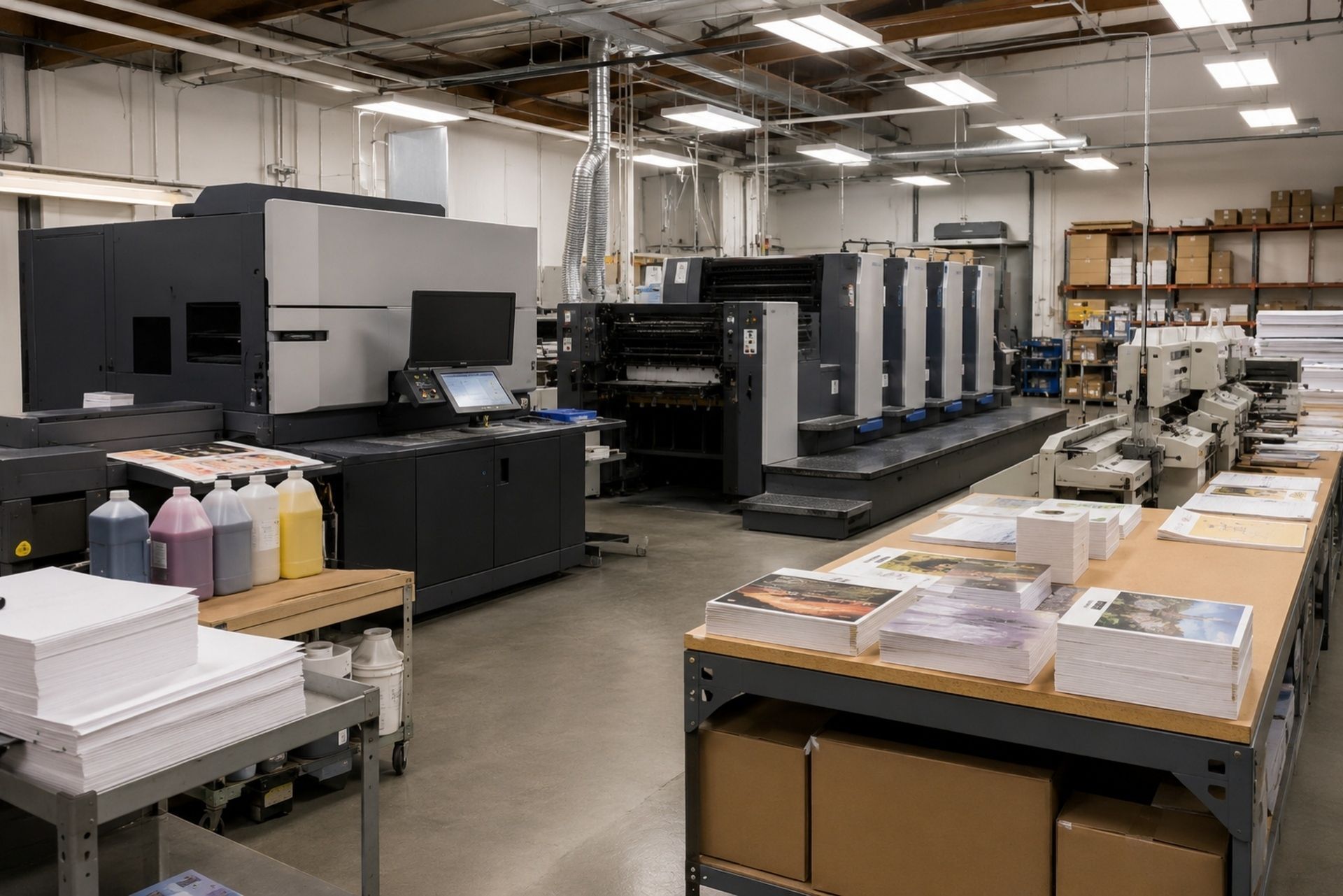
A mid-range commercial digital press costs between $50,000 and $300,000. Wide-format printers, finishing equipment, laminators, and binding machines add up quickly. Standard commercial property insurance covers fire, theft, and certain weather events, but equipment breakdown coverage is a separate endorsement you'll want to add. This covers mechanical and electrical failures that aren't caused by external events, like a motherboard failure in your RIP server or a motor burnout in your offset press.
Inventory fluctuations are another concern. During peak seasons like election cycles, graduation season, or holiday promotions, your paper stock and substrate inventory might triple. If your policy limits reflect your slow-season inventory levels, you could be significantly underinsured during your busiest months. Ask your agent about peak season endorsements or blanket coverage that adjusts automatically.
| Coverage Type | What It Covers | Typical Annual Premium |
|---|---|---|
| Commercial Property | Building, equipment, inventory from fire/theft/weather | $1,200 - $4,500 |
| Equipment Breakdown | Mechanical/electrical failure of machinery | $400 - $1,500 |
| General Liability | Third-party bodily injury, property damage | $800 - $2,500 |
| Professional Liability (E&O) | Design errors, missed deadlines, misprints | $600 - $2,000 |
| Commercial Auto | Delivery vehicles, client pickups | $1,200 - $3,500 |
Professional Liability and Errors & Omissions for Design Work
If your shop offers any design services, even basic layout adjustments, you're exposed to professional liability claims. A color mismatch on 10,000 brochures, a typo on business cards, or a missed deadline for a trade show can all result in client lawsuits seeking damages well beyond the original print job's value.
Errors and omissions insurance covers these claims. Premiums for small to mid-size print shops typically run $600 to $2,000 annually, depending on your revenue and the scope of design work you perform. One thing to keep in mind: most E&O policies have a retroactive date, meaning they won't cover claims arising from work done before that date. If you're switching carriers, make sure there's no gap in your retroactive coverage.
Workplace Safety and Washington L&I Requirements
Washington is one of only four states that operates a monopolistic state workers' compensation fund through the Department of Labor & Industries (L&I). You can't buy workers' comp from a private insurer here. Every print shop with employees must participate in the state fund.
Chemical Handling and Ventilation Standards
Print shops use solvents, UV-curable inks, adhesives, and cleaning chemicals that all carry health risks. Washington's Division of Occupational Safety and Health (DOSH) enforces ventilation standards that are often stricter than federal OSHA requirements. Your shop needs proper exhaust ventilation near screen-washing stations, solvent storage areas, and anywhere aerosol sprays are used.
Maintaining Safety Data Sheets for every chemical on-site isn't optional. DOSH inspectors can show up unannounced, and violations carry fines starting at $1,000 per infraction. Repeated or willful violations can reach $70,000 or more. Document your ventilation maintenance schedule, keep chemical inventories current, and train every employee on proper handling procedures at least annually.
Workers' Compensation and Industrial Insurance Compliance
Washington L&I sets workers' comp rates by risk classification. Print shops generally fall under classification codes like 4101 (printing) or 4109 (screen printing), with rates that vary based on your specific operations. As of 2026, expect to pay roughly $0.80 to $1.50 per $100 of payroll for standard printing operations, though rates shift annually based on industry claim history.
Washington state officials
approved an average 21% rate increase for individual health insurance plans effective January 2026, which affects the broader cost environment for small businesses. While that figure applies to health insurance rather than workers' comp directly, it reflects rising healthcare costs that ripple through all employer-sponsored coverage. Missing L&I premium payments can result in penalties of up to 10% per month, and operating without coverage is a gross misdemeanor in Washington.
Environmental Regulations for Print Shops in the Pacific Northwest
Washington takes environmental compliance seriously, and print shops generate waste streams that fall under multiple regulatory categories.
Waste Disposal and Ink Recycling Mandates
Solvent-based inks, cleaning rags saturated with chemicals, and expired substrates all qualify as hazardous waste depending on their composition. If your shop generates more than 220 pounds of hazardous waste per month, you're classified as a small quantity generator and must follow specific storage, labeling, and disposal protocols.
Ink recycling programs exist through several Washington-based waste management companies, and participating can actually reduce your disposal costs. Some shops have cut their hazardous waste bills by 30-40% by switching to water-based inks where possible and consolidating waste pickups. Keep manifests for every hazardous waste shipment for at least three years.
Adhering to Washington Department of Ecology Guidelines
The Department of Ecology regulates air emissions, water discharge, and solid waste for print operations. If your shop uses solvent-based cleaning systems, you may need an air quality permit depending on your annual volatile organic compound emissions. Shops emitting more than 2 tons of VOCs per year typically need a registration permit at minimum.
Stormwater runoff is another concern, especially for shops with outdoor storage areas or loading docks. If ink containers, substrates, or chemicals are stored where rain can reach them, you need a stormwater pollution prevention plan. Violations can carry fines of up to $10,000 per day, and the Department of Ecology has increased enforcement actions in recent years.
Intellectual Property and Contractual Protections
Print shops sit at an interesting intersection of copyright law. You're producing physical copies of creative work, and the question of who owns what can get contentious fast.
Copyright Ownership in Custom Print Orders
Unless your service agreement states otherwise, the copyright to original artwork created by your in-house designers may belong to your shop, not the client. This surprises many business owners on both sides. If a client hires you to design a logo and print it on merchandise, you should clarify ownership in writing before the project starts.
On the flip side, printing copyrighted material without authorization exposes your shop to infringement claims. A client asking you to reproduce a Disney character on 500 t-shirts without a license puts your business at risk, not just theirs. Establish a clear policy for verifying reproduction rights on every order.
Drafting Robust Service Agreements and Proof Approval Policies
Your service agreement should cover proof approval processes, payment terms, turnaround guarantees, and liability limitations. A signed proof approval form is your best defense against "that's not what I ordered" disputes. Require clients to sign off on digital proofs before production begins, and keep those records for at least two years.
Include a limitation of liability clause that caps your financial exposure at the value of the print job. Without this, a client could argue that your misprinted flyers caused them to lose a $50,000 contract, and you'd have no contractual protection against that claim.
Cybersecurity and Customer Data Privacy
Securing Proprietary Client Files and Digital Assets
Print shops store sensitive client files: logos, proprietary designs, marketing materials before public launch, and sometimes personal data for variable-data printing projects like direct mail campaigns. A data breach doesn't just damage trust. It can trigger notification requirements under Washington's data breach notification law, which requires you to notify affected individuals within 30 days.
Cyber liability insurance covers breach response costs, including forensic investigation, client notification, credit monitoring, and legal defense. Premiums for small print shops typically range from $500 to $1,500 annually. Back up client files to encrypted cloud storage, use strong access controls on your prepress workstations, and purge completed project files on a regular schedule.
FAQ
How much does print shop insurance cost in Washington? Most small to mid-size shops pay between $3,000 and $12,000 annually for a comprehensive package including property, general liability, and equipment breakdown coverage. Your specific costs depend on revenue, equipment value, employee count, and location.
Can I buy workers' comp from a private insurer in Washington? No. Washington operates a monopolistic state fund through the Department of Labor & Industries. All employers must purchase workers' compensation through L&I.
Do I need environmental permits to run a print shop? It depends on your operations. Shops using solvent-based inks or cleaning systems that emit more than 2 tons of VOCs annually typically need an air quality permit from the Department of Ecology.
What happens if a client sues over a misprint? Professional liability (E&O) insurance covers legal defense and damages from errors like color mismatches, typos, or missed deadlines. Without it, you're paying out of pocket.
Does my commercial property policy cover equipment breakdowns? Usually not. Standard property policies cover external events like fire and theft. You'll need a separate equipment breakdown endorsement for mechanical or electrical failures.
Protecting your Washington print shop requires more than a single insurance policy. It demands a layered approach that accounts for your equipment, your employees, your environmental footprint, and your contractual relationships. Start by documenting your total equipment value, annual payroll, and revenue figures. Then request quotes from at least three agents, including independent agents who can compare multiple carriers. Review your L&I classification code to make sure you're not overpaying on workers' comp premiums, and schedule an annual policy review to adjust coverage as your business grows. The shops that survive unexpected losses are the ones that planned for them before they happened.

About The Author:
Jackson Hering
I'm a fourth-generation insurance agent, having learned the business firsthand while working alongside my father. With years of experience passed down through my family, I take pride in combining that legacy knowledge with a modern, client-focused approach. I started my career at a small, family-owned agency and worked my way up, gaining a deep understanding of the industry from the ground up.
Contact Us
Coverage for Everyday Life
Personal Insurance That Works for You
We help individuals and families find coverage that keeps life moving—without overpaying or getting lost in fine print. From auto and home insurance to umbrella and life protection, our licensed team compares options across top-rated carriers to make sure you’re covered the right way, right now.
Auto Insurance
Drive with confidence and coverage that fits your needs.
Home Insurance
Coverage for fire, theft, liability, and more.
Renters Insurance
Affordable protection for your belongings and personal liability.

Boat Insurance
Coverage for watercraft damage, liability, and gear.
Life Insurance
Prepare for the future with term or whole life policies.
Umbrella Insurance
Extra liability protection for life’s bigger risks.
Protect Your Business Without the Guesswork
Business Insurance Built for Stability & Growth
Running a business comes with risk. We help reduce it. Our team builds custom coverage for your needs, including general liability, property, commercial auto, and cyber protection. We’re fast, responsive, and easy to reach—so your insurance is one less thing to worry about.
Industries We Serve
Tailored by Industry
We understand the risks unique to your business—and how to insure against them.
Contractors & Trades
We help contractors protect their tools, vehicles, job sites, and employees with comprehensive insurance solutions. Whether you’re a general contractor, electrician, plumber, or another trade, we provide the coverage you need to keep your projects moving forward safely.
Cannabis Industry
Mosaic specializes in insuring the unique risks of the cannabis industry, including growers, retailers, processors, and delivery services. We understand the compliance challenges you face and work with carriers who can protect every stage of your operation.

Lessor’s Risk (LRO)
If you own a building and lease space to commercial tenants, we help protect your property and liability as a landlord. Our policies safeguard your investment from damages, lawsuits, and other risks that come with leasing commercial real estate.
Frequently Asked Questions
Quick Answers. Trusted Support.
Insurance doesn’t have to be confusing. We’re here to make everything clear, helpful, and hassle-free.
What states is Mosaic Insurance licensed in?
Mosaic is licensed in more than 10 states, including Washington, Oregon, Arizona, California, Texas, Colorado, and more. Our team can help you whether you live locally in WA or operate across multiple state lines.
We’re especially well-equipped to help clients with multi-state businesses, real estate portfolios, or cannabis operations that need compliance-ready coverage in various jurisdictions.
Can I get quotes from multiple carriers through Mosaic?
Yes. As an independent agency, we partner with a wide range of top-rated insurance carriers. That means you’re not locked into just one company’s pricing or coverage limitations.
Our advisors compare quotes for you, break down the differences, and help you choose the plan that fits best—no pressure, just honest advice.
Does Mosaic offer cannabis insurance, and who qualifies?
Absolutely. Mosaic is one of the few agencies with deep experience in cannabis insurance. We offer coverage for dispensaries, cultivators, delivery services, manufacturers, and labs.
If you're in a licensed state and need coverage that meets regulatory requirements, we can help set you up with carriers who understand the cannabis industry’s unique risks.
What can I do through the client portal?
You can use our 24/7 client portal to request policy changes, submit certificates of insurance, and manage your billing. It’s easy to use and always available.
This helps speed up business tasks and gives you full access to your coverage—even outside of regular office hours.
What should I expect after requesting a quote?
Once you request a quote, our team will reach out to gather a few key details. From there, we shop coverage with multiple carriers and return with clear, personalized options.
We make it easy to compare policies, ask questions, and finalize your protection—usually in 24–48 hours.
Can Mosaic help me file a claim?
Yes. Whether it’s an auto accident, property damage, or business-related issue, we’re here to guide you through the claims process. Our team can explain your coverage, contact the carrier, and help get things moving quickly.
We’re your advocate—before, during, and after a claim. You don’t have to go it alone.
Tips, News & Insights
Explore Our Blog