
Top 3 Recommended Policies

By: Jackson Hering
Licensed Personal Insurance Specialist
425-409-2497
A single strip of misaligned wallcovering in a luxury Seattle penthouse can cost you thousands. Maybe the adhesive reacted with a freshly skimmed wall, or a custom hand-printed mural started peeling three weeks after installation. These aren't hypothetical nightmares: they're the exact claims that paperhanging contractors in Washington face every year. And without the right insurance, one bad job can undo years of hard work.
If you're a wallcovering installer working anywhere in Washington state, your risk profile looks different from a general painter or drywall contractor. You're handling expensive materials that belong to your clients, working inside finished homes and commercial spaces, and your liability doesn't end when you pack up your tools. The adhesive you chose, the surface prep you performed, and the seams you rolled all carry risk that can surface weeks or months later. That's why insurance built specifically for paperhanging contractors matters so much more than a generic contractor policy.
This guide covers everything from
general liability and bonding requirements to completed operations, commercial auto, and the often-overlooked "care, custody, and control" gap that catches so many wallcovering pros off guard. Whether you're a solo installer working residential jobs in Tacoma or running a crew that handles commercial wallcovering across the Puget Sound, you'll find specific, practical guidance on building the right coverage package for your business.
Essential Insurance for Washington Paperhanging Contractors
Washington state treats specialty contractors, including paperhanging and wallcovering installers, differently than general contractors in several important ways. Your licensing, bonding, and insurance requirements are specific to your trade classification, and falling short on any of them can mean fines, license suspension, or personal liability in a lawsuit.
Most paperhanging contractors need, at minimum, general liability insurance, a contractor surety bond, and workers' compensation coverage (if you have employees). Many commercial clients and general contractors won't hire you without proof of all three. Understanding what each covers, and where the gaps are, is the first step toward protecting your business.
General Liability and Property Damage Limits
General liability (GL) is the foundation of your coverage. It protects you if a client, visitor, or third party is injured on the job site, or if you damage someone else's property during work. For paperhanging contractors, property damage claims are far more common than bodily injury claims. Think: a ladder scraping a hardwood floor, adhesive splashing onto a client's furniture, or a water tray overturning on carpet.
Standard GL policies for Washington contractors typically start at $1 million per occurrence and $2 million aggregate. Some commercial jobs, especially in Seattle's downtown high-rises, require $5 million or more. Annual premiums for a solo paperhanging contractor generally range from $500 to $2,500, depending on your revenue, claims history, and the types of spaces you work in. Higher-end residential and commercial work pushes premiums up because the potential damage costs are greater.
Washington State Contractor Bond Requirements
Every registered contractor in Washington must carry a surety bond. As of 2026, the Washington Department of Labor & Industries (L&I) has increased the mandatory surety bond requirement for specialty contractors. This bond doesn't protect you: it protects your clients. If you fail to complete a job, cause damage, or violate your contract, the bond provides a financial guarantee the client can claim against.
You can
compare bond costs and requirements through licensed surety providers, but expect to pay between 1% and 5% of the bond amount annually, depending on your credit score and business history. Letting your bond lapse, even briefly, can trigger automatic suspension of your
contractor registration with L&I. That means you can't legally work, period.
Protecting Customer Property and High-End Materials
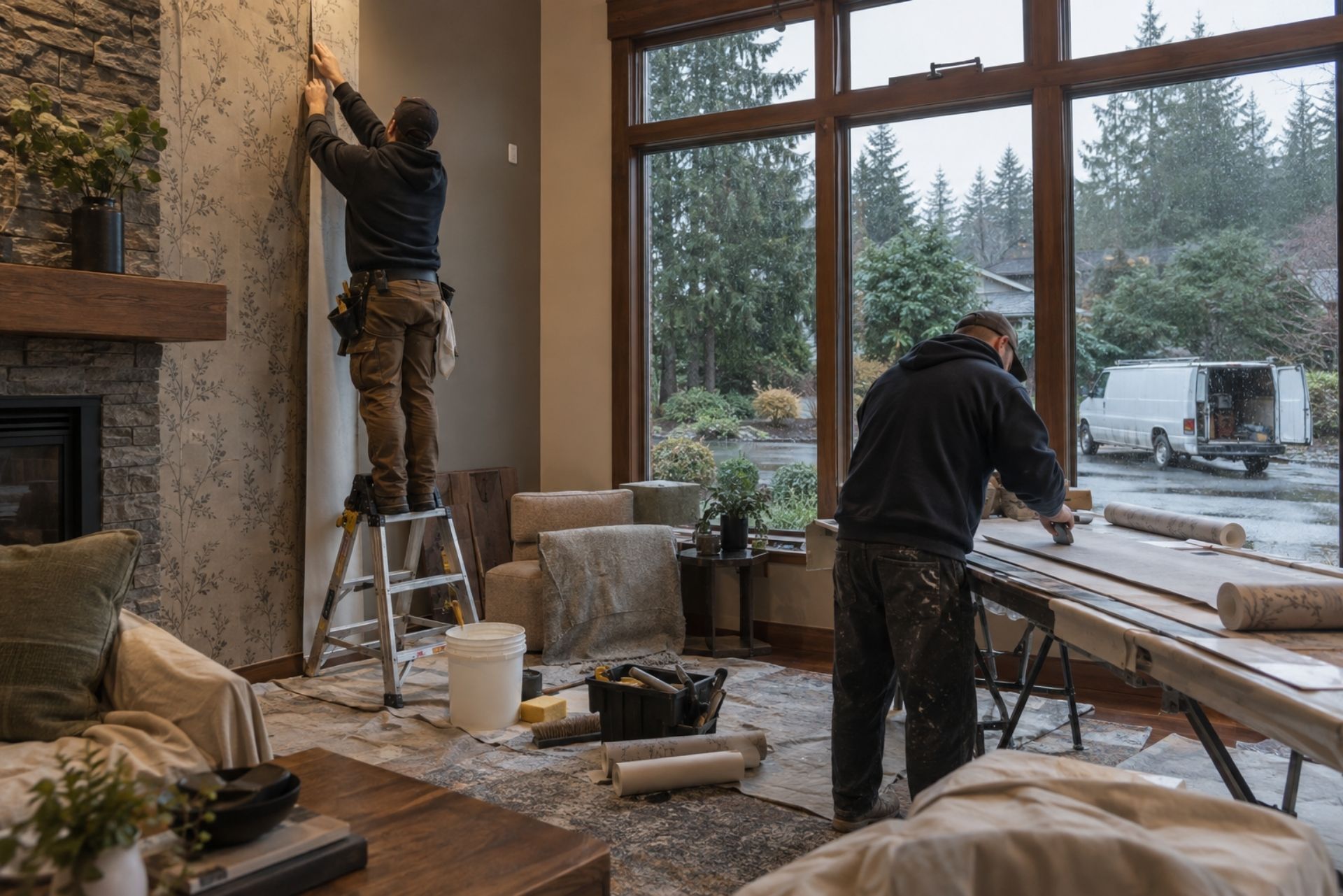
Paperhanging is an intimate trade. You're working inside someone's home or business, often in finished spaces with expensive furnishings, custom millwork, and delicate surfaces. The materials you install can be just as valuable: hand-printed wallpapers from European studios routinely cost $200 to $500 per roll, and custom murals can run into the tens of thousands. Your insurance needs to account for all of it.
Care, Custody, and Control: Why It Matters for Wallcoverings
Here's a gap that catches many contractors off guard. Standard general liability policies typically exclude damage to property that's in your "care, custody, or control" (CCC). That means if a client hands you 30 rolls of imported silk wallcovering and you store them in your van overnight where they get water-damaged, your GL policy likely won't pay the claim.
You need an installation floater or a CCC endorsement added to your policy. This covers client-owned materials while they're in your possession, whether stored in your shop, transported in your vehicle, or staged on-site waiting for installation. For high-end residential work, this is non-negotiable. A single ruined shipment of designer wallcovering can easily exceed $5,000 to $15,000, and that's before the client's designer adds rush reorder fees.
Adhesive Failures and Surface Prep Liability
Adhesive selection and surface preparation are where most paperhanging claims originate. You chose a clay-based adhesive for a vinyl wallcovering in a humid bathroom, and six months later, the seams are lifting. Or you didn't properly prime a new drywall surface, and the wallpaper is bubbling within weeks. These scenarios create liability even when you followed the manufacturer's instructions, because the client hired you as the expert.
Your GL policy's "products-completed operations" coverage handles some of this, but not all. If the adhesive itself was defective, the manufacturer may share liability. If you mixed it incorrectly or used the wrong type, it's on you. Document everything: the adhesive brand and batch number, the primer used, the substrate condition before you started, and the temperature and humidity during installation. This documentation is your best defense if a claim arises.
Completed Operations: Risks After the Job Is Done
Completed operations coverage is the part of your GL policy that responds to claims made after you've finished a job and left the site. For paperhanging contractors, this is critical. Wallcovering failures often don't show up immediately. Seam separation, adhesive bleed-through, color fading from improper UV protection: these problems can emerge weeks or months after installation.
Without completed operations coverage, you'd be personally responsible for repair costs, material replacement, and potentially the cost of hiring another installer to fix your work. Washington courts have held contractors liable for
completed work defects even years after installation in some cases. Make sure your policy doesn't sunset completed operations coverage too early: a minimum of two years is standard, but five years is better for high-end work.
Coverage Comparison: Basic vs. Comprehensive Protection
Not every paperhanging contractor needs the same level of coverage. A part-time installer doing weekend accent walls has different exposure than a company handling full commercial wallcovering installations. Here's how basic and comprehensive packages typically compare:
| Coverage Element | Basic Package | Comprehensive Package |
|---|---|---|
| General Liability | $1M / $2M aggregate | $2M+ / $5M aggregate |
| Surety Bond | State minimum | State minimum |
| Care, Custody, Control | Not included | Included (up to $25K-$50K) |
| Completed Operations | 1-2 year tail | 5+ year tail |
| Inland Marine (Tools) | Not included | $10K-$50K coverage |
| Commercial Auto | Not included | Included with hired/non-owned |
| Umbrella Policy | Not included | $1M-$5M excess liability |
| Estimated Annual Cost | $500-$1,500 | $2,500-$6,000+ |
The basic package works for low-volume residential installers with modest tool inventories. If you're handling commercial projects, working with materials valued above $5,000 per job, or running a crew, the comprehensive package is where you should be. Washington's contractor insurance requirements set the floor, but smart contractors build well above it.
Insuring Your Gear: Tools, Equipment, and Commercial Auto
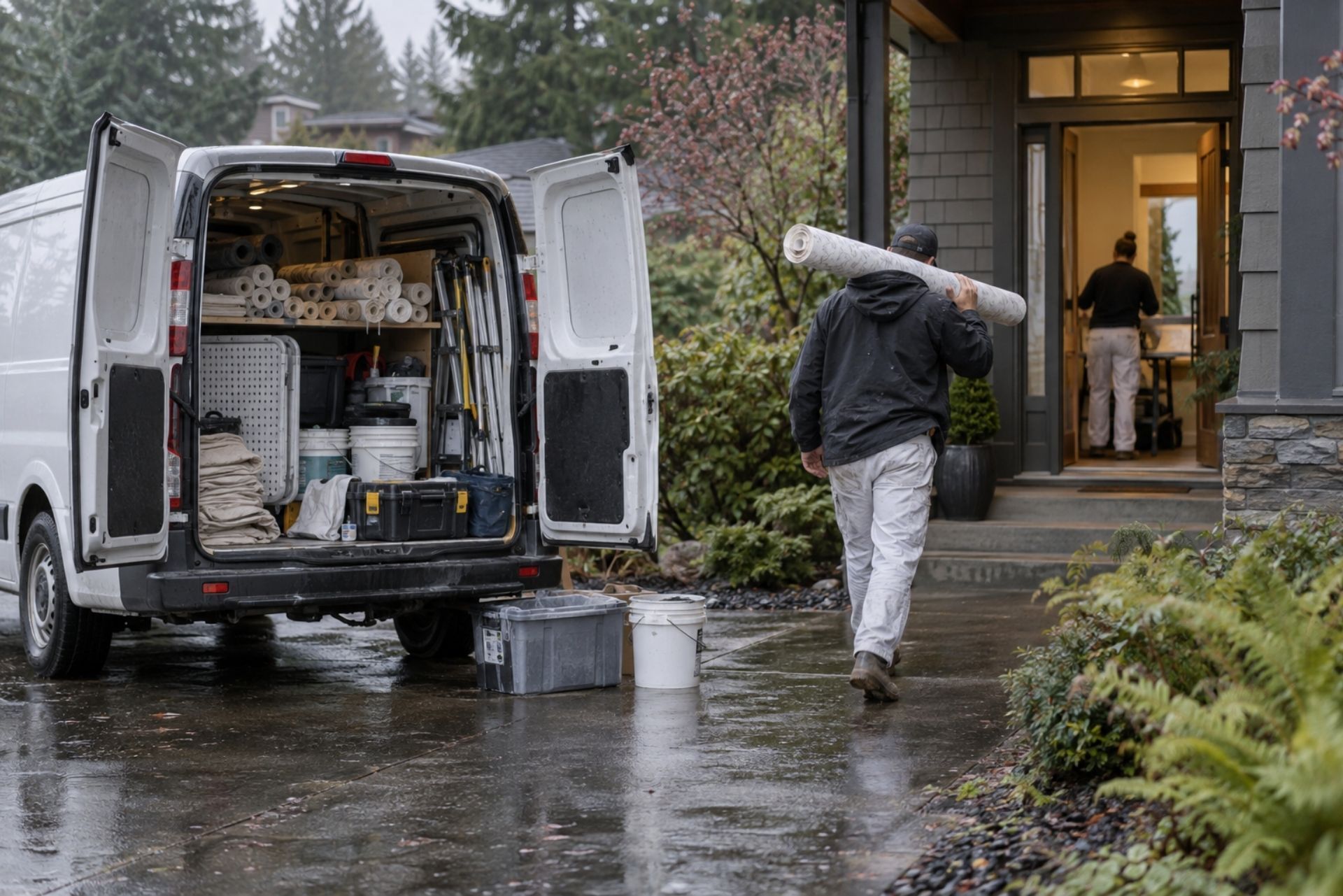
Your tools and vehicle are what make your business run. A stolen scaffold, a broken steamer, or a van totaled on I-5 can shut you down for days or weeks. Standard business insurance doesn't automatically cover these assets the way most contractors assume.
Inland Marine Coverage for Specialty Tools and Ladders
Inland marine insurance covers tools and equipment that move between job sites. For paperhanging contractors, this includes paste machines, steamers, specialty cutting tools, scaffolding, laser levels, and smoothing equipment. A full professional kit can easily represent $5,000 to $15,000 in value.
Your homeowner's policy won't cover tools used for business. Your GL policy won't either. Inland marine fills that gap, covering theft, damage, and loss whether your equipment is in your van, on a job site, or in storage. Premiums are typically 1% to 3% of the total insured value annually, making it one of the most affordable coverages you can add.
Commercial Auto: Personal Policy Gaps for Contractors
If you drive a personal vehicle to job sites, your personal auto insurance has a significant gap. Most personal policies exclude claims that occur while the vehicle is being used for business purposes. That means if you're hauling wallcovering supplies to a client's home and cause an accident, your personal insurer can deny the claim entirely.
Commercial auto insurance closes this gap. It covers your vehicle, liability to others, and cargo while you're conducting business. If you hire subcontractors who drive their own vehicles, you'll also want hired and non-owned auto coverage, which protects you if they cause an accident while working for you. Washington
requires all contractors to carry appropriate insurance matching their business activities, and using a personal policy for commercial work doesn't meet that standard.
Common Questions About Paperhanging Insurance
How much does insurance cost for a solo wallcovering installer in Washington? Expect to pay $800 to $2,000 per year for a basic GL policy with a surety bond. Adding inland marine and commercial auto pushes the total to $2,500 to $4,500 annually.
Do I need workers' comp if I work alone? Washington requires workers' comp through L&I for all employees. Sole proprietors can opt into coverage voluntarily, which is smart since medical bills from a ladder fall can easily hit six figures. Washington's state-run workers' comp system handles this differently than most states.
Does my insurance cover the wallpaper itself if I damage it during installation? Only if you have a care, custody, and control endorsement or installation floater. Standard GL excludes property in your possession.
What if a client claims my work failed six months after installation? Your completed operations coverage handles this, as long as the claim falls within your policy's coverage period. Keep detailed job records with photos and material documentation.
Can I use my personal truck for business and still be covered? Not reliably. Personal auto policies routinely deny claims involving business use. You need a commercial auto policy or a business-use endorsement at minimum.
Are there special requirements for commercial wallcovering jobs in Seattle? Many commercial property managers and GCs require $2M to $5M in GL coverage, plus certificates of insurance naming them as additional insureds. Check contract requirements before bidding.
Before You Buy a Policy
Getting the right insurance for your paperhanging business isn't about buying the cheapest policy you can find. It's about matching your actual risk exposure to the right coverages. Start by documenting your annual revenue, the typical value of materials you handle, your tool inventory, and whether you use employees or subcontractors. These four data points drive almost every quote you'll receive.
Talk to at least three agents, and make sure at least one specializes in contractor insurance. A generalist agent may not understand why care, custody, and control matters for your trade, or why a two-year completed operations tail isn't enough for commercial work. With wallcovering installation costs continuing to rise in 2026, the materials you're responsible for are more valuable than ever.
Your reputation as a paperhanging contractor depends on the quality of your work. Your financial survival depends on the quality of your insurance. Build both with the same level of care, and you'll have a business that lasts.

About The Author:
Jackson Hering
I'm a fourth-generation insurance agent, having learned the business firsthand while working alongside my father. With years of experience passed down through my family, I take pride in combining that legacy knowledge with a modern, client-focused approach. I started my career at a small, family-owned agency and worked my way up, gaining a deep understanding of the industry from the ground up.
Contact Us
Coverage for Everyday Life
Personal Insurance That Works for You
We help individuals and families find coverage that keeps life moving—without overpaying or getting lost in fine print. From auto and home insurance to umbrella and life protection, our licensed team compares options across top-rated carriers to make sure you’re covered the right way, right now.
Auto Insurance
Drive with confidence and coverage that fits your needs.
Home Insurance
Coverage for fire, theft, liability, and more.
Renters Insurance
Affordable protection for your belongings and personal liability.

Boat Insurance
Coverage for watercraft damage, liability, and gear.
Life Insurance
Prepare for the future with term or whole life policies.
Umbrella Insurance
Extra liability protection for life’s bigger risks.
Protect Your Business Without the Guesswork
Business Insurance Built for Stability & Growth
Running a business comes with risk. We help reduce it. Our team builds custom coverage for your needs, including general liability, property, commercial auto, and cyber protection. We’re fast, responsive, and easy to reach—so your insurance is one less thing to worry about.
Industries We Serve
Tailored by Industry
We understand the risks unique to your business—and how to insure against them.
Contractors & Trades
We help contractors protect their tools, vehicles, job sites, and employees with comprehensive insurance solutions. Whether you’re a general contractor, electrician, plumber, or another trade, we provide the coverage you need to keep your projects moving forward safely.
Cannabis Industry
Mosaic specializes in insuring the unique risks of the cannabis industry, including growers, retailers, processors, and delivery services. We understand the compliance challenges you face and work with carriers who can protect every stage of your operation.


Lessor’s Risk (LRO)
If you own a building and lease space to commercial tenants, we help protect your property and liability as a landlord. Our policies safeguard your investment from damages, lawsuits, and other risks that come with leasing commercial real estate.

Frequently Asked Questions
Quick Answers. Trusted Support.
Insurance doesn’t have to be confusing. We’re here to make everything clear, helpful, and hassle-free.
What states is Mosaic Insurance licensed in?
Mosaic is licensed in more than 10 states, including Washington, Oregon, Arizona, California, Texas, Colorado, and more. Our team can help you whether you live locally in WA or operate across multiple state lines.
We’re especially well-equipped to help clients with multi-state businesses, real estate portfolios, or cannabis operations that need compliance-ready coverage in various jurisdictions.
Can I get quotes from multiple carriers through Mosaic?
Yes. As an independent agency, we partner with a wide range of top-rated insurance carriers. That means you’re not locked into just one company’s pricing or coverage limitations.
Our advisors compare quotes for you, break down the differences, and help you choose the plan that fits best—no pressure, just honest advice.
Does Mosaic offer cannabis insurance, and who qualifies?
Absolutely. Mosaic is one of the few agencies with deep experience in cannabis insurance. We offer coverage for dispensaries, cultivators, delivery services, manufacturers, and labs.
If you're in a licensed state and need coverage that meets regulatory requirements, we can help set you up with carriers who understand the cannabis industry’s unique risks.
What can I do through the client portal?
You can use our 24/7 client portal to request policy changes, submit certificates of insurance, and manage your billing. It’s easy to use and always available.
This helps speed up business tasks and gives you full access to your coverage—even outside of regular office hours.
What should I expect after requesting a quote?
Once you request a quote, our team will reach out to gather a few key details. From there, we shop coverage with multiple carriers and return with clear, personalized options.
We make it easy to compare policies, ask questions, and finalize your protection—usually in 24–48 hours.
Can Mosaic help me file a claim?
Yes. Whether it’s an auto accident, property damage, or business-related issue, we’re here to guide you through the claims process. Our team can explain your coverage, contact the carrier, and help get things moving quickly.
We’re your advocate—before, during, and after a claim. You don’t have to go it alone.
Tips, News & Insights
Explore Our Blog